

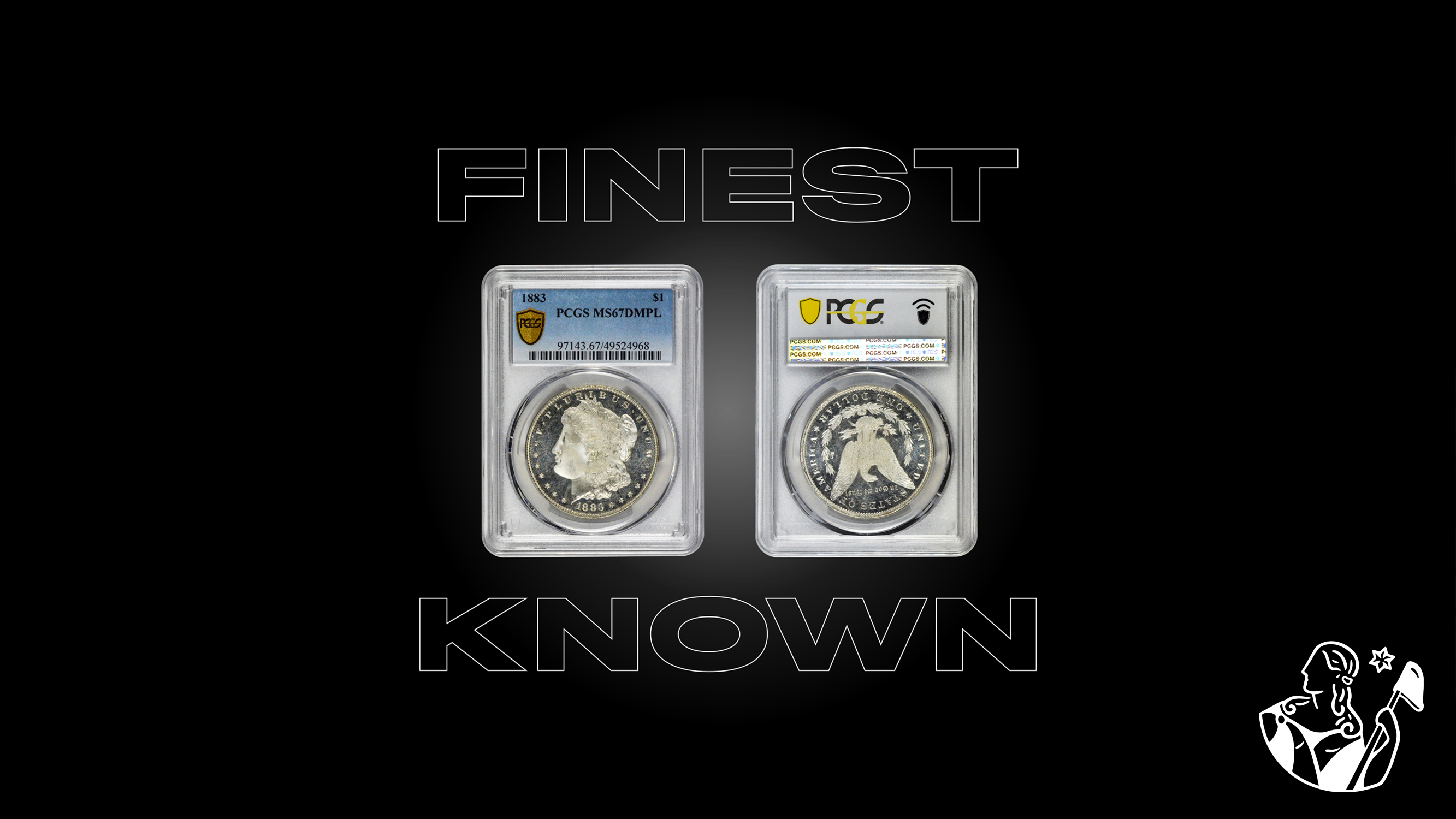
Morgan Dollar Populations: The Extreme Scarcity of DMPL vs. Standard MS
Morgan Dollar Populations: The Extreme Scarcity of DMPL vs. Standard MS
For serious collectors of classic American coinage, the Morgan Silver Dollar stands as the ultimate canvas. Among these historic silver pieces, there is a specialized subset of coins that command massive premiums and intense demand: Deep Mirror Prooflike (DMPL) specimens.
To the untrained eye, a standard Mint State (MS) Morgan and a DMPL Morgan are both technically "uncirculated" coins. However, when you look beneath the surface at the physical mechanics of the U.S. Mint—and back it up with the data found in the official PCGS Morgan Dollar Population Report—the staggering rarity of true DMPL coins becomes undeniably clear.
What Makes a Morgan Dollar "DMPL"?
It is a common misconception that DMPL is a numeric grade. In reality, "Deep Mirror Prooflike" is a special surface designation awarded by third-party grading services like PCGS to business-strike coins that happen to mimic the characteristics of a specially prepared Proof coin.
To achieve this designation, a coin must possess clear, watery, mirror-like fields that contrast sharply against heavily frosted devices (the portrait of Liberty and the eagle). PCGS specifically requires that a coin exhibit a minimum of four inches of clear photographic reflectivity on both the obverse and reverse sides to earn the coveted DMPL label.
The Mechanical Flaw That Created a Rarity
The reason DMPL Morgan Dollars are so incredibly scarce comes down to the operational realities of the U.S. Mint in the late 19th and early 20th centuries.
When a mint worker installed a brand-new, freshly polished pair of steel coin dies into a pressing machine, the first few dozen coins struck would absorb that intense, mirror-like polish off the die face. However, as hard silver blanks were slammed into the steel dies at immense pressure, thousands of times an hour, the microscopic polishing lines on the die face quickly wore away.
Within just a few hundred strikes, the die surface degraded from a deep mirror finish to a standard satiny or frosty texture. The "prooflike window" for a set of dies was devastatingly short, meaning only a microscopic fraction of any given mintage year could ever physically emerge from the mint as a DMPL.
The Proof Is in the Population Data
You do not have to guess at this scarcity; the numbers in official industry population statistics provide clear evidence. Even when evaluating the most common, best-struck dates in the entire series, the population drop-off is immense.
Take the **1880-S Morgan Dollar** as the definitive benchmark. The San Francisco Mint was renowned for its spectacular striking quality during this era, making the 1880-S by far one of the most common dates to be awarded a DMPL designation. Yet, look at how the total certified populations broadly stack up across all grades:
- Grading services have certified an incredibly large population of over 187,000 total 1880-S silver dollars in standard, regular-strike Mint State (MS) grades.
- By contrast, across all grade levels combined, the DMPL designation has been awarded to just over 3,000 total coins.
Even for the literal "poster child" of prooflike Morgan Dollars, the DMPL survivors account for a meager fraction—less than 2%—of the standard Mint State population. When you move away from the highly optimized San Francisco strikes and look at tougher Philadelphia issues, New Orleans mintages, or scarcer dates, the numbers become brutally small. For a massive portion of the series, the surviving DMPL population at *any* grade level drops down to double or single digits—and some dates have zero known examples.
Why Collectors Hunt for the DMPL Designation
Because regular MS populations are so vast compared to the restrictive DMPL populations, a DMPL coin is insulated by a double layer of numismatic rarity. It is rare not just because of its numerical grade, but because of the physical way it caught the light on the day it was struck over a century ago.
For investors and advanced collectors looking to build high-end sets that hold value, chasing low-population DMPL designations is the ultimate pursuit. They represent the absolute pinnacle of visual drama on historic U.S. silver coinage.
If you are ready to look beyond standard uncirculated strikes and explore the breathtaking depth of low-population, mirror-surface condition rarities, explore our premier online inventory of certified classic silver dollars or visit our showroom to view these historic masterpieces under proper lighting.
Rinkor Rare Coins, LLC
2600 Mendocino Avenue, Suite C
Santa Rosa, CA 95403
707-546-2575