

America’s Forgotten Silver Masterpiece: The History and Mystery of the Gobrecht Dollar
Mike Rinkor
America’s Forgotten Silver Masterpiece: The History and Mystery of the Gobrecht Dollar
In the grand tapestry of American silver coinage, few series evoke as much mystery, artistic beauty, and technical fascination as the Gobrecht Dollar. Produced in extremely small quantities between 1836 and 1839, these massive silver pieces served as both a practical test for federal minting machinery and the artistic template that defined U.S. silver coins for over half a century.
For over thirty years—following the suspension of silver dollar production in 1804—the United States Mint did not produce circulating dollar coins. By the mid-1830s, under the direction of Mint Director Robert M. Patterson and Assistant Engraver Christian Gobrecht, the Mint set out to reintroduce the flagship denomination with a dramatic, neoclassical redesign.
1. The Birth of Seated Liberty and the Flying Eagle
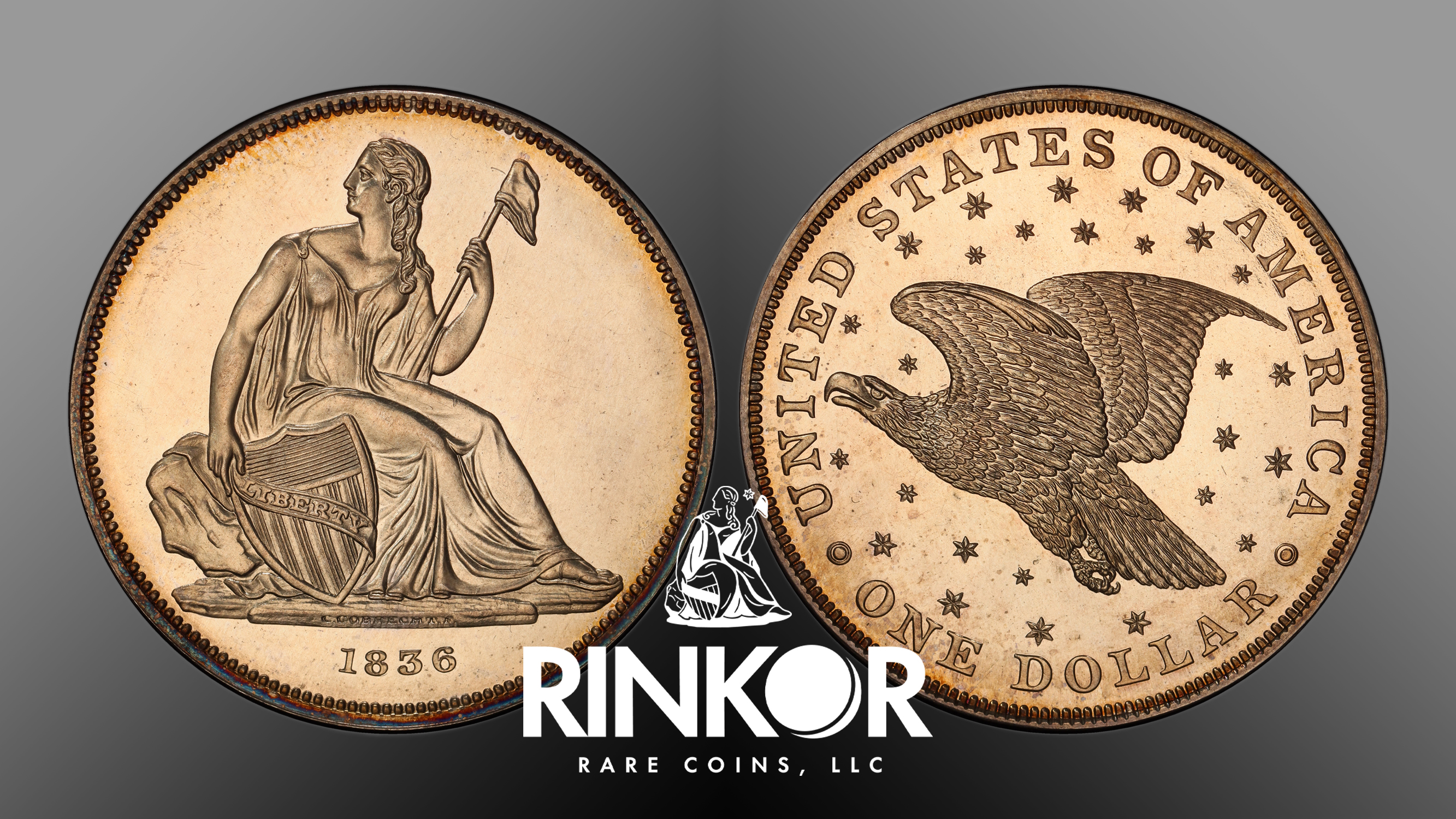
To replace the heraldic designs of the early Republic, Christian Gobrecht executed a revolutionary vision based on sketches by renowned artists Thomas Sully and Titian Peale. The obverse featured a majestic Liberty seated upon a rock, holding a pole topped with a Phrygian cap and supporting the shield of the Union.
The reverse presented an equally bold artistic leap: a majestic, soaring bald eagle moving through a field of stars. Unlike previous rigid, heraldic eagles, Gobrecht’s eagle was dynamic, lifelike, and full of fluid movement. This iconic reverse design was so acclaimed that it was later resurrected for the famous Flying Eagle Cent of 1856–1858.
2. The Inscription Controversy and Technical Testing
The first regular strikes of the Gobrecht Dollar appeared in late December 1836, when exactly 1,000 pieces were produced for distribution into circulation. However, these early strikes ignited immediate controversy.
Gobrecht had prominently engraved his signature—"C. GOBRECHT F." (an abbreviation for the Latin Fecit, meaning "made it")—directly on the base of Liberty's seat. Critics felt the placement was overly vain for an official state coin. The backlash was so immediate that mint workers ground the signature off the dies for later runs, making the early 1836 "Signature on Base" varieties highly prized by specialized numismatists today.
3. The Alignment Mysteries: Coin vs. Medal Orientation
What makes Gobrecht Dollars exceptionally captivating to advanced collectors are the chaotic die alignments and restrike variations produced during their brief run.
- Coin Alignment (180° Turn): Standard U.S. coins are struck so that when you flip the coin horizontally side-to-side, the reverse appears right-side up.
- Medal Alignment (0° Turn): Medals are struck so that when you flip the piece vertically top-to-bottom, the reverse design remains right-side up.
Because Gobrecht Dollars were produced both as pattern trial pieces, official circulation strikes, and later "restrikes" made for government officials and influential 1850s collectors, they exist with a baffling array of die orientations. Some feature stars on the reverse flying horizontally, others flying upward, some with plain edges, and others with reeded edges. Dissecting these die alignment pairings (categorized by prominent numismatic scholar John W. Dannreuther) remains one of the most rewarding pursuits in classic silver collecting.
A Crucial Bridge in American History
Though only a few thousand original and restrike Gobrecht Dollars were ever minted across all varieties, their artistic impact was enormous. The Seated Liberty obverse pioneered on Gobrecht’s patterns was immediately adopted for half dimes, dimes, quarters, half dollars, and the regular-issue Seated Liberty Dollar introduced in 1840.
Today, a genuine Gobrecht Dollar represents an extraordinary bridge between the primitive early days of the Philadelphia Mint and the golden age of 19th-century American coinage. Whether appreciated as a major rarity or studied as a mechanical masterpiece, it remains one of the ultimate centerpieces of advanced silver collecting.
If you are interested in exploring classic U.S. silver type coins or adding historically significant condition rarities to your portfolio, our team is always available to offer expert guidance and market analysis.
Rinkor Rare Coins, LLC
2600 Mendocino Avenue, Suite C
Santa Rosa, CA 95403
707-546-2575