

Understanding Coin Finishes: A Collector’s Guide to Surface Variations
Understanding Coin Finishes: A Collector’s Guide to Surface Variations
For passionate collectors, a coin’s finish is far more than a simple aesthetic trait—it is a window into the craftsmanship, intentionality, and technology of the minting process. The way a die is prepared and struck entirely alters how a coin interacts with light, ultimately dictating its appearance, surface texture, and numismatic designation.
Whether studying classic pre-1933 gold, Morgan Dollars, or modern issues like the American Eagle series, identifying the characteristics of different coin finishes is essential to understanding how a coin was manufactured and how it is categorized in population reports.
1. Business Strike (Uncirculated / Mint State)
The "business strike" represents the standard production method intended for everyday commerce or bulk bullion distribution. Swept through high-speed presses at hundreds of coins per minute, these pieces drop into massive bins, creating minor contact marks or "bag marks" from contact with other coins. These pieces showcase a uniform, satiny luster with a distinct "cartwheel effect" radiating across the surfaces when rotated under a single light source.
The Prooflike (PL) and Deep Mirror Prooflike (DMPL) Phenomenon: Occasionally, when fresh, highly polished business dies strike the first few hundred planchets, the resulting business strike coins accidentally mimic the deep, reflective look of a true proof. This is most famously celebrated in Morgan Silver Dollars, where PCGS and NGC award PL and DMPL designations to pieces with exceptional mirror depths in the fields. However, this phenomenon is not exclusive to silver; a tiny, incredibly elusive population of Pre-1933 U.S. Gold coins and other vintage series also exhibit true Prooflike surfaces due to highly polished dies.
2. Traditional Proof Finishes
Proof coins are meticulously produced explicitly for collectors and are not meant for general circulation. The minting process involves specially treated, highly polished dies and hand-fed planchets (coin blanks) that are struck at least twice at slower speeds to ensure razor-sharp details and full design execution.
- The Visual Look: A classic modern proof features deep, mirror-like fields (the flat background areas) contrasted against heavily frosted, matte design details (the devices). This stark, dual-toned visual effect is known as a cameo or ultra/deep cameo contrast.
- Production Characteristics: In vintage series, proof coins were struck in extremely limited quantities, often with original mintages under a few thousand pieces, compared to the millions struck for commerce. Collectors can easily compare standard bullion fields with these highly polished varieties when looking at classic and modern Silver Eagles.
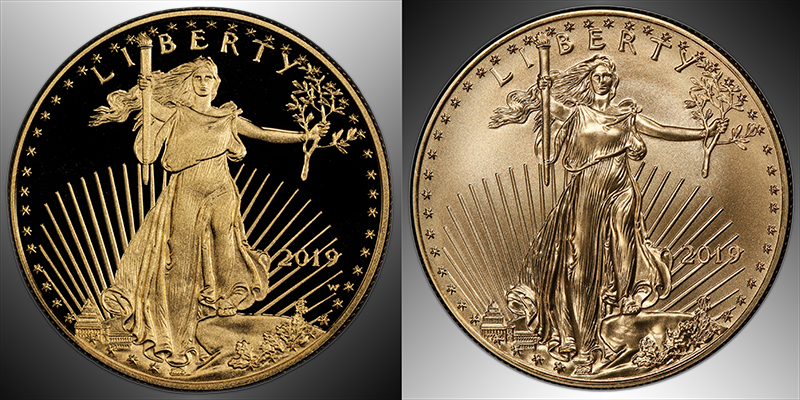
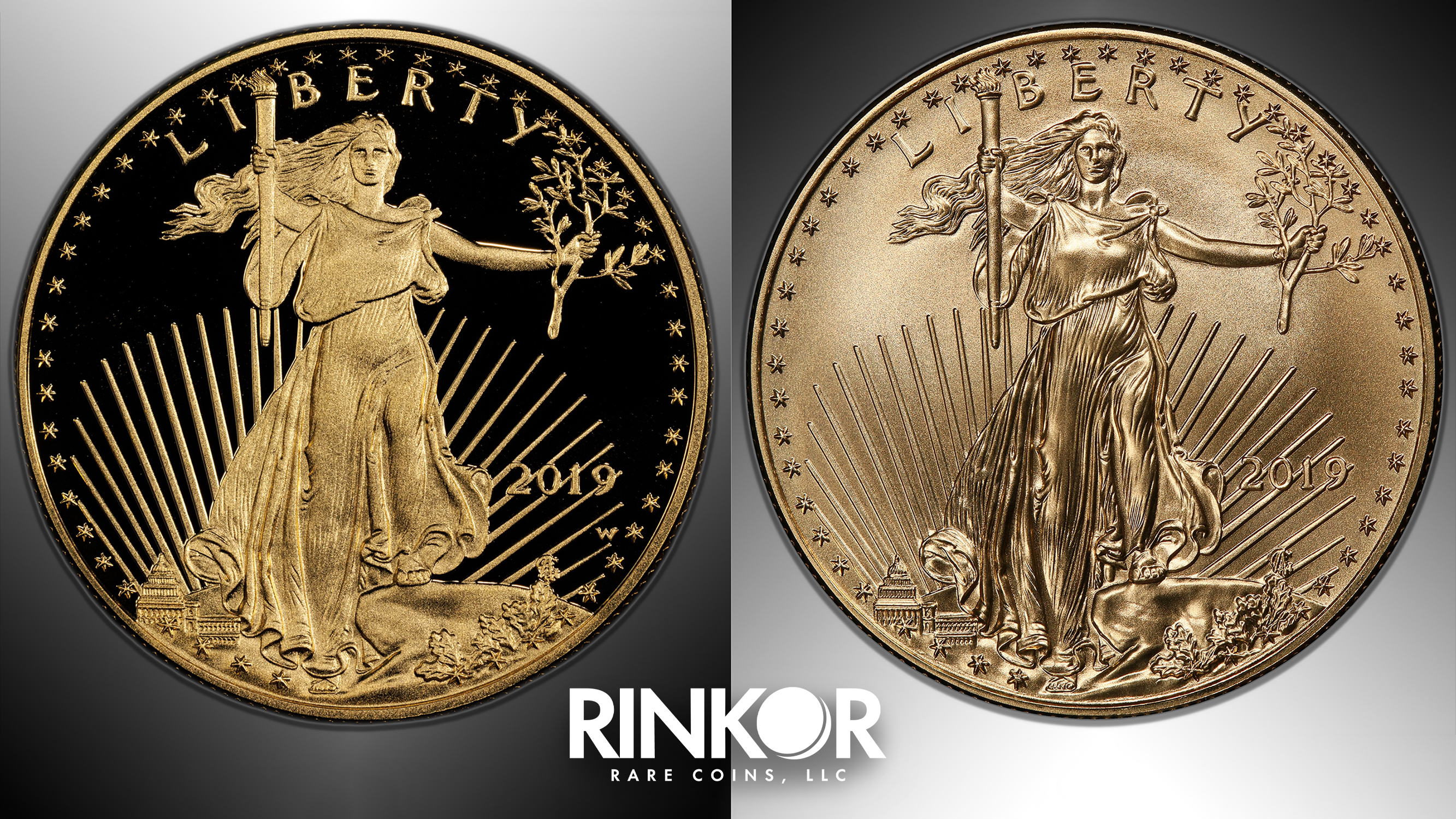
Visualizing the contrast: A high-cameo Proof strike alongside a traditional Uncirculated/Business strike.
3. Reverse Proof Finishes
A modern innovation popularized by major sovereign mints for special commemorative issues and anniversary sets, the Reverse Proof completely inverts the traditional proof aesthetic.
- The Visual Look: On a reverse proof coin, the fields are given a beautiful, frosted or satin texture, while the raised design elements (like Lady Liberty, the portraits, or lettering) are polished to a brilliant, dark mirror shine.
4. Matte Proof & Satin Finishes
Popularized in the early 20th century during the Renaissance of American coinage—and still utilized in selective modern sets—matte and satin finishes bypass the traditional flashy mirror look in favor of an understated, elegant texture.
- Matte Proofs: Frequently seen on classic Buffalo Nickels or Lincoln Cents from 1909 to 1916, these feature a granular, sandblasted appearance that minimizes reflections but showcases incredible, crisp sculptural detail. Because early matte proofs lacked mirror surfaces, they were often confused for regular pocket change by the public, leading to low survival rates in pristine condition today.
- Satin Finishes: Offer a silky, experimental texture bridging the gap between business and proof strikes. This elegant style saw a magnificent resurgence with modern satin finish releases, such as the 2016 Centennial Gold series (the Mercury Dime, Standing Liberty Quarter, and Walking Liberty Half Dollar). These pieces were deliberately struck with a soft, smooth satin luster to faithfully capture the historic texture intended by the original twentieth-century artists, and examples can be explored in modern Gold Commemoratives sets.
5. Burnished Finishes (Uncirculated Collector Strikes)
Primarily associated with the modern American Silver Eagle series (bearing the "W" mint mark and launched in 2006), the burnished finish represents a distinct middle ground for collectors who appreciate an ultra-clean, uniform look.
- The Visual Look: Before minting, the raw coin blanks (planchets) are placed into rotating drums filled with a specialized media or polishing agents. This "burnishing" process cleans and smooths the surfaces before striking. The result is a coin with a soft, uniform, matte-like sheen that lacks the bright "cartwheel" flash of a business strike but avoids the deep mirrors of a proof.
If you have questions about the finishes, designations, or varieties within your own collection, our team is always here to help you evaluate your pieces.
Rinkor Rare Coins, LLC
2600 Mendocino Avenue, Suite C
Santa Rosa, CA 95403
707-546-2575